Strange stories often survive as copies of copies. These sixteen begin somewhere firmer: a museum object, an archive catalogue, a scientific institution or a contemporary record. Each gives us a place to start, and each leaves a different kind of question open.
The Carrington Event and Bell inequality experiments describe measured physical effects. Nürnberg and Basel survive as printed objects shaped by sixteenth-century belief. Roswell, Socorro and Rendlesham live in witness reports and incomplete archives. Together they form a paper trail through events that still attract serious attention.
Nürnberg, 14 April 1561
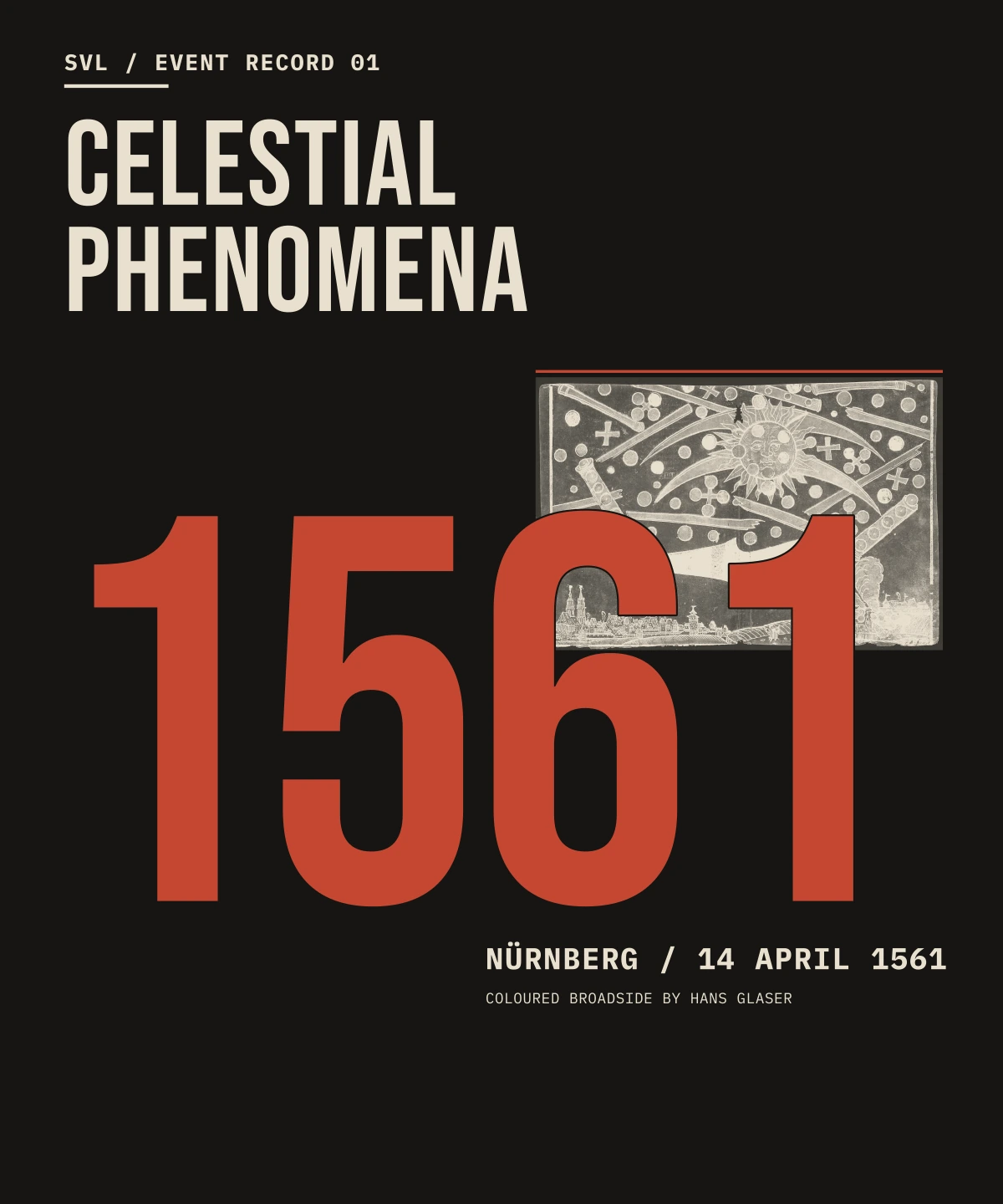
Hans Glaser's coloured broadside is the visual centre of Launch 01. The surviving sheet combines a woodcut with letterpress and measures 25.8 by 38 centimetres. Its title records a celestial appearance over Nürnberg on 14 April 1561. The Zentralbibliothek Zürich holds the object and makes the complete sheet available to study online.1
The image is often recast online as a literal aerial battle. The archive description supplies a more useful historical frame: Glaser interpreted the spectacle through divine omnipotence. The sheet belongs to a culture in which unusual skies could be read as warnings. Its circles, rods and dark descending form remain extraordinary, but the modern UFO label came centuries later.1
Basel, July and August 1566
Five years later, Samuel Coccius described unusual appearances around sunrise and sunset over Basel. The archive record dates them to 27 and 28 July and 7 August 1566, and identifies the black spherical forms that dominate the woodcut. Like Glaser, Coccius presented the event as an omen and a call to repentance.2
The Basel sheet matters because it shows how printers turned fleeting reports into durable public images. It preserves what people saw, or believed they saw, and considered significant enough to print in 1566. The nature of those black forms remains open to interpretation.
Utsuro-bune, 1803
The National Archives of Japan preserves Takizawa Okinobu's illustrated account commonly known as Utsuro-bune, or hollow vessel. The manuscript describes a round vessel with glass panels and an iron-plated base in Hitachi Province in the third year of Kyōwa, equivalent to 1803.3
The vessel's structure invites modern comparisons with a spacecraft, while the surrounding account belongs unmistakably to Edo-period storytelling. The manuscript preserves both possibilities in the imagination: a cultural narrative and a remarkably unfamiliar encounter. That tension is precisely why it endures.
Carrington and Tunguska: the sky leaves damage
On 1 September 1859, Richard Carrington observed an intense white-light solar flare. NASA's historical timeline links it to the geomagnetic storm that followed about 17 hours later. Aurorae were seen as far south as Cuba, while telegraph systems failed, shocked operators and in some cases caught fire.4
Tunguska left a different signature. On 30 June 1908 an object exploded in the atmosphere over Siberia, flattening roughly 500,000 acres of forest without leaving a conventional impact crater. NASA modelling places the likely stony body at about 50 to 80 metres across and the airburst six to nine miles above the ground, while acknowledging that important uncertainties remain.5
Roswell, July 1947
Roswell's power comes partly from how quickly the official language changed. On 8 July 1947, the Roswell Army Air Field public information office announced the recovery of a "flying disc". The following day, press reports identified the material as a radar-tracking weather balloon.6
A 1995 review by the U.S. Government Accountability Office found only two surviving federal records from 1947 that referred to the incident: a unit history and an FBI teletype. The review also found that some outgoing-message and administrative records from the airfield had been destroyed, with no surviving explanation of when or under whose authority. The Air Force's later account connected the debris to a classified balloon project intended to monitor Soviet nuclear activity.6
The Air Force later identified Project Mogul as the most likely source of the debris, a conclusion that accounts for the classified programme behind the balloon explanation. The surviving record is still unusually sparse: a dramatic first announcement, an immediate reversal and unexplained gaps in the files. That unfinished sequence is why Roswell continues to invite questions.
Socorro and Shag Harbour
The Air Force file for Socorro describes a white, egg or oval-shaped object on the ground near Socorro, New Mexico, on 24 April 1964. It was reported as standing on girder-like legs. The account records a roar, blue and orange flame beneath the object, a vertical rise to roughly fifteen or twenty feet and a rapid departure over the landscape. The case remained unidentified in the Project Blue Book record.10
Shag Harbour is associated with reports of lights over the water in Nova Scotia on 4 October 1967. Library and Archives Canada's guide is a route into the government's wider UFO holdings, not a complete case file in itself. We use it as a starting point and leave the nature of the reported event open.11
The Wow! Signal, 15 August 1977
The Big Ear radio telescope detected a strong, narrow-band signal that rose and fell as a fixed point in the sky would cross the telescope's beam. Its six printed characters, 6EQUJ5, were intensity values averaged in ten-second intervals. They were never a sentence or a decoded message.7
The observation lasted 72 seconds and has never appeared again in a confirmed repeat detection. Jerry Ehman, who marked the computer printout with "Wow!", continued to take its unusual profile seriously while leaving its origin open. One powerful signal, detected once and never explained, is enough to keep the question alive.7
Rendlesham Forest, December 1980
Britain's National Archives catalogue describes DEFE 24/1948 as a file of reports concerning sightings in Rendlesham Forest in December 1980. One detail is easy to miss: the catalogue record itself covers papers assembled from 1992 to 2002. It should not be mistaken for a single contemporaneous 1980 memo.8
That distinction gives the case a clearer timeline. The original reports, the later papers and the decades of retelling all belong to the story, but they entered the record at different moments.
Phoenix, 13 March 1997
Hundreds of people reported lights over Arizona on 13 March 1997. A contemporary CNN report records differing descriptions and an unresolved public argument three months later. Some witnesses described a formation that seemed to move; others focused on lights hanging over the city.9
Those accounts should not be compressed into one flight path, one enormous craft or one explanation. The useful record is the scale of the sighting and the disagreement inside it.
1I/2017 U1 ʻOumuamua
Discovered on 19 October 2017, ʻOumuamua was the first known interstellar object observed passing through our solar system.12 Its barycentric orbit was significantly hyperbolic, meaning it was not gravitationally bound to the Sun. The discovery prompted the International Astronomical Union to create the permanent I designation for interstellar objects.13
The formal name, discovery date and unbound passage are firmly established. Claims about a precise shape or artificial origin remain interpretations. The confirmed fact, a visitor from beyond the solar system, needs no embellishment.
Four records of an ordered cosmos
Albrecht Dürer's 1515 woodcut of the southern celestial hemisphere maps the sky as a designed surface.14 A 1732 cosmological plan held by Wellcome Collection sets the systems of Ptolemy, Tycho Brahe and Copernicus beside one another, turning a changing model of the universe into a single engraved field.15
A second Wellcome object, John Emslie's coloured diagram of the Moon's phases from about 1850, was made with tracing paper so the relationship between Sun, Earth and Moon could be demonstrated through movement.16 These are not paranormal records. They show the visual tools people built to make distant systems legible.
The final Core study begins with Bell inequalities. The 2022 Nobel Prize in Physics recognised experiments with entangled photons that established violations of those inequalities and advanced quantum information science. The measured correlations defy the limits expected from local hidden-variable theories, opening one of the strangest confirmed chapters in modern physics.17
A record is a beginning
These sources do not close the cases. They show where responsible curiosity can begin. Follow the numbered citations below to inspect the archive objects, catalogue descriptions and scientific accounts for yourself.
References
Sources and further reading
- Zentralbibliothek Zürich: Nürnberg celestial phenomenon, 1561
Catalogue record, high-resolution scan and physical description for Hans Glaser's broadside.
- Zentralbibliothek Zürich: Basel celestial phenomena, 1566
Catalogue record and scan of the Samuel Coccius and Samuel Apiarius broadside.
- National Archives of Japan: Utsuro-bune manuscript
Official archive record with four high-resolution manuscript images and attribution.
- NASA History: solar science timeline
Historical account of Carrington's observation and the 1859 geomagnetic storm.
- NASA: Tunguska revisited
Event summary and modern modelling of the Tunguska airburst.
- U.S. GAO: Results of a search for records concerning Roswell
The 1995 federal records review, including the two located 1947 records and documented record destruction.
- SETI Institute: The Wow! Signal
Technical explanation of the signal profile, the 6EQUJ5 intensity scale and the limits of the evidence.
- The National Archives: Rendlesham Forest catalogue record
Official catalogue description for DEFE 24/1948, including its scope and covering dates.
- CNN archive: Arizona lights, 19 June 1997
A contemporary report preserving witness disagreement and the unresolved debate after the Phoenix sightings.
- U.S. National Archives: Socorro case file
The digitised federal archive item used for the date, location and limited event description.
- Library and Archives Canada: UFO research guide
Official research route into Canada's government UFO holdings; it is contextual rather than a complete Shag Harbour case file.
- NASA Science: ʻOumuamua
NASA's overview of the discovery and status of the first known interstellar object observed in our solar system.
- Minor Planet Center: MPEC 2017-V17
The permanent 1I designation, name and hyperbolic orbital status of ʻOumuamua.
- The Met: Dürer's southern celestial globe
Object record, dimensions and image of the 1515 woodcut.
- Wellcome Collection: a plan of the solar system
Collection record for the 1732 engraving comparing three cosmological systems.
- Wellcome Collection: the phases of the Moon
Collection record for John Emslie's coloured transparent diagram.
- Nobel Prize: Physics 2022
Official account of the Bell inequality experiments recognised by the 2022 prize.