
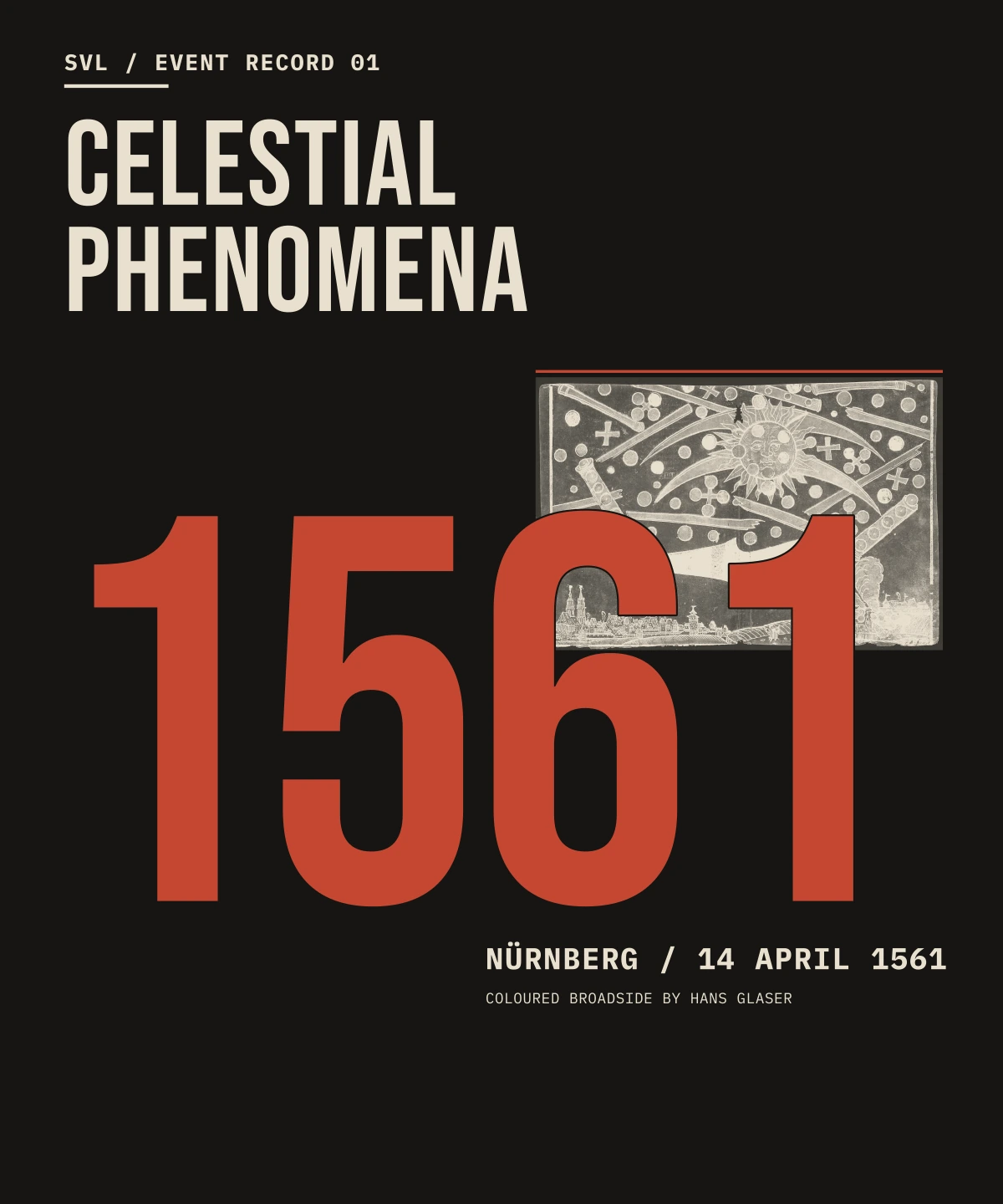
On 14 April 1561, according to a broadside printed by Hans Glaser, the sky over Nürnberg filled with unfamiliar forms. Circles cluster around the Sun. Rods, crosses and curved shapes occupy the upper field. A dark spear-like object descends towards a landscape outside the city walls.1
The image is immediate enough to feel modern. The object that carries it is not. It is a single coloured sheet made from woodcut and letterpress, produced in a world where news, wonder, religion and warning could occupy the same page.
The surviving object
The Zentralbibliothek Zürich catalogues the sheet as a report of a celestial phenomenon over Nürnberg. It measures 25.8 by 38 centimetres and was printed in Nürnberg in 1561. The archive attributes both authorship and printing to Glaser, and preserves the image as a high-resolution digital object.1
Those details matter. Online reproductions often detach the picture from its text, crop it aggressively or colour it anew. The archive record lets us return to a specific physical sheet with a known holder and persistent identifier.
How Glaser understood the sky
The archive description says Glaser interpreted the event as a demonstration of divine omnipotence. That places the sheet within the early modern tradition of prodigy broadsides: reports of unusual natural or celestial events presented as moral signs.1
Modern readers often see an aerial conflict in the image. Glaser understood the same scene as a religious warning. The distance between those readings is part of the broadside's power: one recorded sky can carry radically different meanings across four and a half centuries.
Why it still feels strange
Historical context makes the image stranger, not smaller. Its force comes from the collision between recognisable landscape and unreadable sky. The city sits below as a scale reference. Above it, simple printed forms become an event that the page cannot fully organise.
That is why the broadside belongs at the centre of Event Records. It is a beautiful, unsettling object with a verifiable history. We can look directly at what survived, understand the world that produced it and still admit that the image has not lost its charge.
References
Sources and further reading
- Zentralbibliothek Zürich: Nürnberg celestial phenomenon, 1561
The item-level catalogue record, full digital scan, physical description and rights status for Hans Glaser's broadside.