
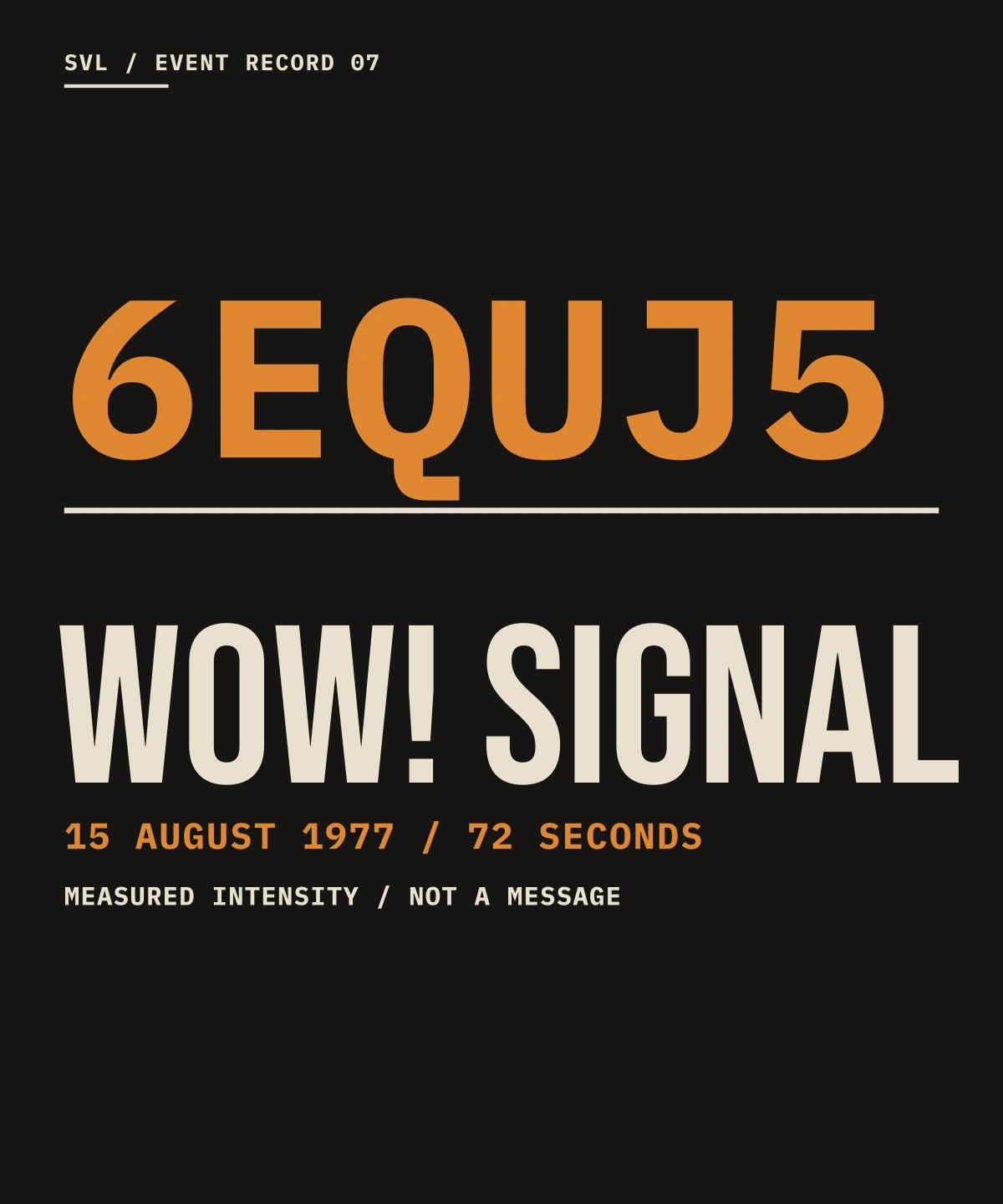
On 15 August 1977, Ohio State University's Big Ear radio telescope registered an unusually strong narrow-band signal. It appeared during a search for signals that might indicate extraterrestrial technology. The observation lasted for the full 72 seconds that a fixed point in the sky would take to pass through the telescope's beam.1
Astronomer Jerry Ehman saw the sequence 6EQUJ5 on the computer printout, circled it and wrote "Wow!" in the margin. The handwritten reaction named the event. The characters themselves describe what the instrument measured.1
It is an intensity scale
Big Ear sampled the strength of each radio channel in ten-second intervals. Its software printed one character for each measurement. The digits 1 to 9 represented increasing signal-to-noise values; letters continued the same scale above 9. Read in order, 6EQUJ5 shows the signal becoming much stronger and then fading.1
That rise and fall is important. It is consistent with a distant, fixed source crossing the antenna pattern as Earth rotated. It is not language, a cipher or six characters sent by an intelligence.1
Why 72 seconds matters
Big Ear did not steer to follow a source. The sky drifted through its fixed observing beam. A point-like celestial source would therefore be available for a limited window, producing a characteristic increase and decrease in strength. The Wow! Signal matched that window unusually well.1
No one noticed the signal until Ehman reviewed the printout the following morning, so there was no immediate independent confirmation. Later observations could return to the same region, but they could not replay that first 72-second window.1
The unanswered signal
The signal was narrow-band and strong, qualities that made it interesting to SETI researchers. It was observed only once. Big Ear returned to the same area more than 100 times without confirming a recurrence, and later searches have not established the original source.2
Ehman continued to regard the observation as worthy of attention while keeping its origin open. Nearly fifty years later, that is where the signal remains: singular, unexplained and still capable of supporting more than one possibility.2
Why the six characters endure
6EQUJ5 compresses an entire observation into six marks: background, ascent, peak and decline. Once its meaning is understood, it becomes more vivid. It is a tiny graph printed as type, and a record of a signal that behaved plausibly enough to remain interesting nearly fifty years later.
References
Sources and further reading
- SETI Institute: The Wow! Signal
Technical account of Big Ear, the 6EQUJ5 scale, the beam profile and the limits of the observation.
- Ohio State Big Ear archive: The Wow! Signal
The observatory archive on repeat searches and Jerry Ehman's own cautious assessment.